
The short answer: approval belongs to the product and to the brand, not to the factory. You submit the specific paddle model to USA Pickleball, it is tested against the equipment standards, and if it passes it is added to the approved list under your brand name. A factory cannot be “certified”, a different colourway is not automatically covered, and nothing about the process lets a supplier promise you approval in advance.
Why factories cannot be “certified”
This is the single most common misunderstanding in the category, and it is worth being blunt about it.
USA Pickleball approves paddles, identified by model and specification. There is no facility certification programme that makes everything a factory produces approved. So when a supplier says “our factory is USA Pickleball certified”, one of two things is true: they are using the word loosely to mean “we have made paddles that passed”, or they are telling you something that is not true.
What a factory can legitimately say is: we have produced models that went on to be approved for brands we work with, and we build to the specification those approvals were granted against.
That distinction matters commercially. If you buy on the strength of a false claim, you find out at the point where you try to sell into a tournament channel — which is exactly when you have inventory and no approval.
What a submission actually contains
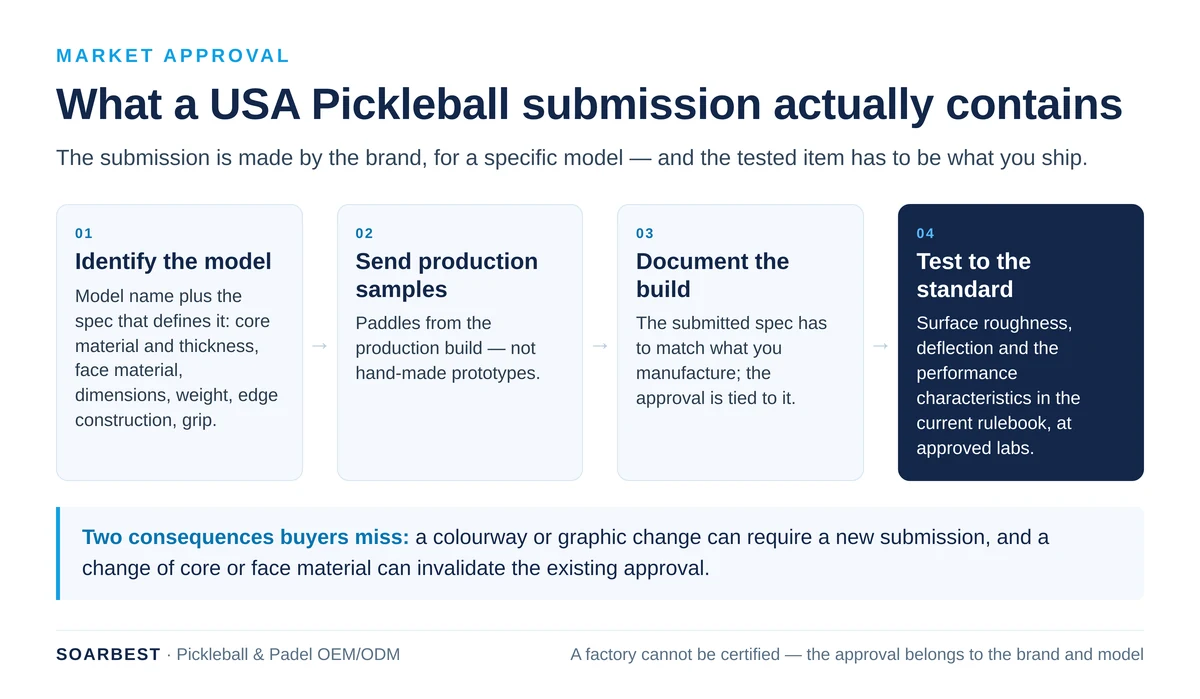
The submission is made by the brand, for a specific model. In practice it involves:
- Product identification. Model name, and the specification that defines it: core material and thickness, face material, dimensions, weight, edge construction, grip.
- Physical samples. Paddles from the production build, not hand-made prototypes — the tested item has to be what you will ship.
- Documentation of the build. The submitted spec has to match what you manufacture, because the approval is tied to it.
- Testing against the equipment standards. Surface roughness, deflection, and the performance characteristics in the current rulebook. Testing is done by approved labs; the standards and the fee schedule are published by USA Pickleball and change over time.
Two consequences: a colourway or graphic change can require a new submission, and a change of core or face material almost always does.
What we do and what we do not
We do: build to the specification you intend to submit, keep the production records consistent with it, and produce the samples for submission from the same line and the same materials as bulk.
We do not: submit on your behalf, guarantee a result, or describe our facility as certified. Approval decisions are made by USA Pickleball, on your product, after testing. Any supplier who tells you otherwise is selling you confidence they do not own.
Budget and timing
Do not build a launch calendar that assumes a fixed approval date. The honest planning position is:
- Fees: published by USA Pickleball in their current fee schedule. Check the schedule directly before you budget — do not take a number from a blog post, including this one.
- Timing: varies with queue and with whether your first submission passes. Plan your retail launch on the assumption that the first submission may need a second attempt.
- Break-in matters. Some thermoformed paddles gain performance as they bed in, and a model tested new and a model tested after break-in are not the same product. Build a break-in step into your own pre-submission checks.
Padel is a different situation entirely
There is no global approval list for padel rackets equivalent to USA Pickleball’s. What you face in the EU is general product safety and market-access obligations — the GPSR framework, your own claims about the product, and your distributor’s compliance requirements. That is a documentation and labelling exercise, not a testing queue.
Do not let a supplier carry a USA Pickleball story into a padel conversation. Two different regimes, two different obligations, and conflating them is a good way to lose a distributor’s trust.
What to do before you commit to a launch date
- Decide the exact model you will submit, and lock its spec sheet.
- Ask your supplier for the production records that will match that spec, not a marketing sheet.
- Check the current USA Pickleball fee schedule and rulebook yourself.
- Plan two submissions into the calendar, and treat the second as contingency rather than failure.
Three things brands get wrong in the first submission
Submitting a hand-made sample. A prototype proves the design works; it does not prove the production build does. If the tested paddle is not the one you will ship, the approval does not protect you.
Changing graphics after approval. A new colourway or a moved logo can put you back in the queue, because the approved item is a specific build. Lock the artwork before submission, not after.
Treating approval as a marketing milestone. Approval is a market-access requirement, not a launch event. Plan the launch on the assumption that the paperwork may be slower than the production run, and you will never be the brand with 3,000 paddles in a warehouse and no channel to sell them into.
Next step
Send us the model you intend to submit and the spec you intend to lock. We will tell you which lines in that spec are most likely to change between sample and bulk — those are the ones that will send you back into a second submission.
Related: Thermoformed vs cold-press, Core thickness and face material, 50 pcs MOQ.
Product lines: Private-label pickleball paddles · Custom padel rackets · Racket bags and covers