
The short answer: cold-press glues the core and two faces together and adds a separate edge guard; thermoforming wraps the whole paddle in one skin and fuses it under heat and pressure. Thermoformed gives more power, a bigger sweet spot and no glued rim to peel. Cold-press gives a softer, more predictable feel and a replaceable edge guard. The trade is durability risk against performance. Neither is “better” — the right answer depends on who is buying and how they replace their paddle.
What each process actually does
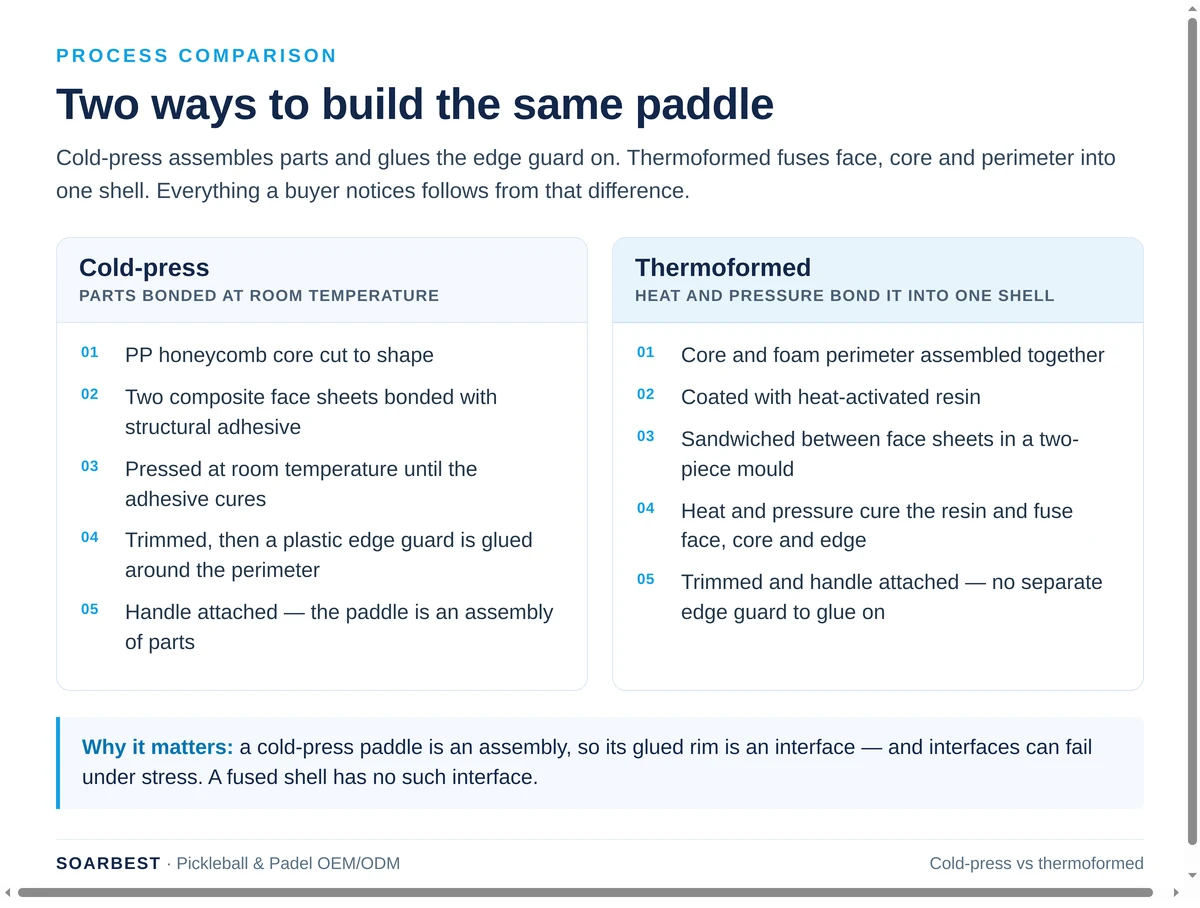
Cold-press. The PP honeycomb core is cut to shape. Two composite face sheets are bonded to it with structural adhesive and pressed at room temperature until the adhesive cures. The paddle is then trimmed, a plastic edge guard is glued around the perimeter, and the handle is attached. The paddle is an assembly of parts, and the perimeter is one of them.
Thermoformed. The core and a foam perimeter are assembled, coated with heat-activated resin, sandwiched between face sheets, and placed in a two-piece mould. Heat and pressure cure the resin and fuse face, core and edge into one piece. There is no glued edge guard: the perimeter is part of the shell.
What changes in the finished product follows directly from that difference. An assembly of parts has interfaces, and interfaces are where cold-press paddles fail: the glued rim peels. A fused shell has no such interface at the edge, which is why thermoformed paddles hold their edge — and why, when they fail, they fail differently.
What a buyer notices on court
| Thermoformed | Cold-press | |
|---|---|---|
| Power | Higher; stiffer face returns more energy | Moderate, more controlled |
| Sweet spot | Larger; foam perimeter stiffens the edges | Smaller; falls away faster off-centre |
| Feel | Crisp, connected, higher-pitched pop | Softer, more muted |
| Break-in | Can gain pop as it beds in | Stays close to day-one feel |
| Main failure mode | Core crush and face-to-core delamination | Edge-guard peel, usually 8–12 months |
The failure modes are the part buyers rarely get told. A cheap thermoformed paddle can have a core that was partially crushed during pressing — which reads as extra power in a demo and goes dead inside a year. And a thermoformed paddle that delaminates does not simply lose power: it can become more powerful and inconsistent, which is why several models have been removed from approval lists after testing.
How to choose for your line
Three questions decide it:
- Who is the player? Control and touch players, older players, club players who keep a paddle for two years: cold-press, done well. Power-first players, tennis converts, players who replace every season: thermoformed.
- What is the warranty you can fund? Thermoformed needs a warranty you are prepared to honour, because the failure mode arrives at 6–18 months, not on day one. If you cannot fund replacements, do not launch thermoformed.
- What is your price band? Thermoformed carries a higher unit cost and expects a higher retail price. If the SKU has to sit at an entry price, cold-press is the honest build.
A useful default for a first collection: one cold-press hero at the price point your channel can actually sell, and thermoformed only if your margin can carry the warranty.
What this changes in your project
- Tooling and sample time. Thermoformed needs a mould; that is a longer first sample and a higher setup cost. Cold-press tooling is simpler and cheaper to change.
- Spec precision. Thermoforming is less forgiving: temperature, pressure and dwell time all affect the core. A supplier that cannot describe how they control core crush is a supplier to walk away from.
- Packaging claims. Do not print “thermoformed” on a cold-press paddle. Buyers cut samples open.
- Repairability. A cold-press edge guard is a replaceable part. A thermoformed shell is not.
Four questions to ask any supplier
- How do you prevent core crush during pressing?
- What is your edge bond check, and what does a failure look like?
- What is the warranty, and who pays the claim — you or the factory?
- Can you show the surface roughness test on a new paddle, not a used one?
If the answers are vague, the pop you felt in the sample may be a defect rather than engineering.
What we will not claim
We will not tell you one process is better. We will not say a factory is “certified” for either. And we will not promise that a thermoformed paddle will pass approval testing — that depends on the finished product, measured after break-in, not on the process name.
Where the price difference actually comes from
Thermoformed is not expensive because the materials are better. It is expensive because of the mould, the press time, the scrap rate and the fact that a failed press is a scrapped paddle rather than a reworkable one.
Three cost lines move when you switch from cold-press to thermoformed:
- Tooling. A two-piece mould costs more than cold-press tooling, and it is model-specific. Change the outline and you may need a new mould.
- Cycle time. Heat, dwell and cool-down per paddle add up across a run.
- Yield. A core that crushes or a shell that wrinkles is scrap. On a 50-pc run the scrap rate is not a rounding error, it is a line on the invoice.
Cold-press is cheaper for a reason that is worth naming: it is an assembly process, so a defect usually costs you one part, not the whole paddle. That is also why the edge guard can be replaced.
Next step
Tell us the player, the retail band and your warranty appetite. We will recommend one of the two builds and sample it once, properly, instead of sampling both and choosing by feel.
Related: Core thickness and face material, USA Pickleball testing, 50 pcs MOQ.
Product lines: Private-label pickleball paddles · Custom padel rackets · Racket bags and covers