
The short answer: core thickness decides the feel and the sweet spot; face material decides the power and the durability. Thicker cores (16 mm) give a softer, more forgiving paddle with a bigger sweet spot; thinner cores (13 mm) give a firmer, faster paddle with more feedback. Fibreglass faces are softer and cheaper; carbon faces are stiffer and more consistent. Decide the player you are selling to before you decide either number — the spec sheet follows the player, not the other way round.
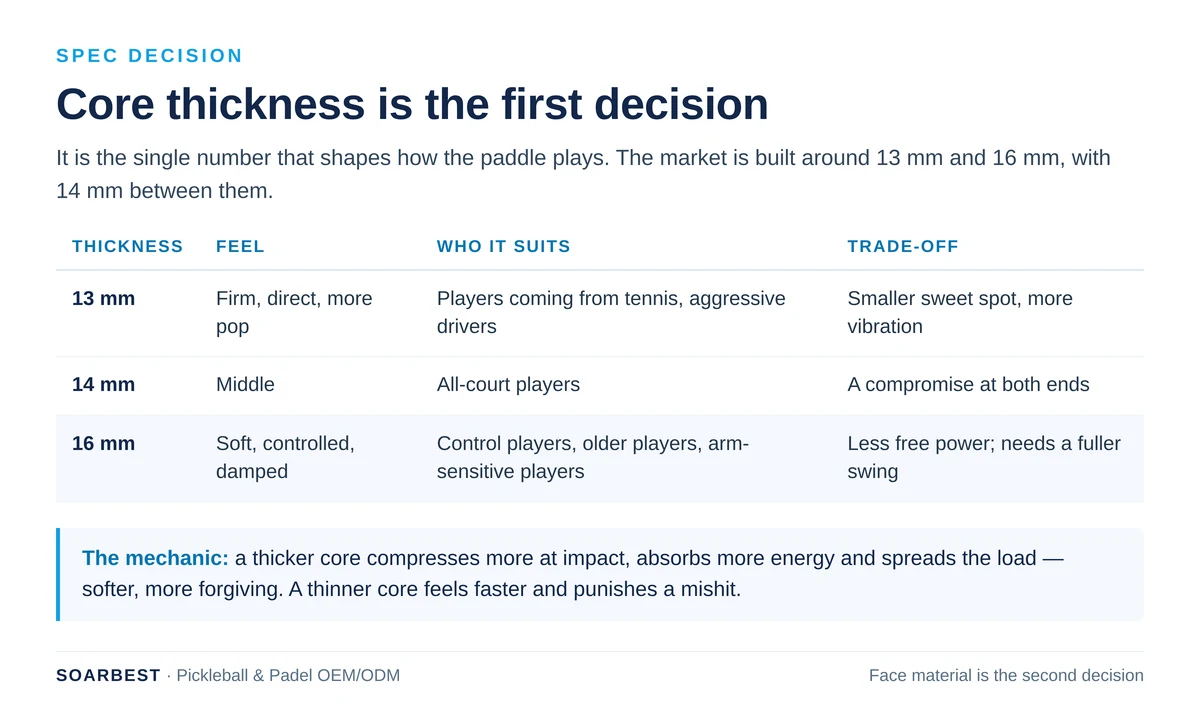
Core thickness: the first decision
Core thickness is measured in millimetres and it is the single number that shapes how the paddle plays. The two widths that dominate the market are 13 mm and 16 mm, with 14 mm in between.
| Thickness | Feel | Who it suits | Trade-off |
|---|---|---|---|
| 13 mm | Firm, direct, more pop | Players coming from tennis, aggressive drivers | Smaller sweet spot, more vibration |
| 14 mm | Middle | All-court players | Compromise on both ends |
| 16 mm | Soft, controlled, damped | Control players, older players, arm-sensitive players | Less free power, needs a fuller swing |
The mechanic is simple: a thicker core compresses more at impact, absorbs more energy, and spreads the load across a wider area. That is why a 16 mm paddle feels softer and forgives off-centre hits, and why a 13 mm paddle feels faster but punishes a mishit.
Core material matters as much as thickness. Polypropylene honeycomb is the standard: light, cheap, predictable. Foam cores are denser and quieter, used in premium and thermoformed builds. If a supplier quotes you a thickness without naming the core material, the quote is incomplete.
Face material: what it changes
The face is what the ball actually touches, and it drives two things buyers care about — power and how long the surface lasts.
- Fibreglass. Softer, more forgiving, cheaper. Good for beginner and intermediate ranges. Wears faster: the texture flattens and spin drops.
- Carbon fibre (including raw carbon and 3K twill weaves). Stiffer, more consistent, better spin retention. The premium default. Higher cost, and surface texture is regulated — roughness is checked when the paddle is new.
- Hybrid laminates. A fibreglass core face with a carbon top layer. Used to hit a price point without losing the “carbon” story.
The practical rule: fibreglass for the entry SKU, carbon for the hero SKU, and do not put a carbon name on a fibreglass face. That is the fastest way to lose a repeat order.
What to put in the spec sheet
A spec sheet that a factory can work to, and a buyer can approve against, needs seven lines:
- Core material and thickness (e.g. PP honeycomb, 16 mm)
- Face material and weave (e.g. raw carbon, 3K twill)
- Overall length, width and weight with tolerance (e.g. 420 mm ± 2 mm, 225 g ± 5 g)
- Grip circumference and grip length
- Edge construction — edge guard, or foam-filled unibody
- Surface texture and the roughness limit you are working to
- Graphics: print method, colour standard, and where the logo sits
Anything not on that list becomes a discussion during sampling, and every discussion during sampling is a week.
The mistake that costs the most
The most expensive mistake is not picking the wrong thickness. It is changing thickness or face material after the sample is approved.
Once the sample is signed off, tooling, print files, core stock and packaging are all set against that spec. Changing the core from 16 mm to 13 mm after approval usually means: new core stock, a new sample round, reprinted packaging, and a bulk slot pushed back by a month. On a first order, that is the difference between a spring launch and a summer one.
The second most expensive mistake is copying a competitor’s spec sheet number by number without knowing why they chose it. Their 16 mm choice was made for their player, their price point and their market. Yours may not be the same player.
How we handle this
We ask three questions before quoting a paddle: who is the player, what is the retail price band, and what does the paddle have to beat on the shelf. The thickness and face follow from those three answers.
Where the answer is unclear, we sample two builds in parallel rather than guessing. Two samples in one round is cheaper than one sample and a second round.
Weight, balance and why the numbers on the box are not the whole story
Two paddles with the same weight can feel completely different. Static weight is what a scale reports; swing weight is what the player feels, and it is driven by where the mass sits. A head-heavy 225 g paddle feels slower than a head-balanced 235 g paddle.
Three numbers belong on your spec sheet alongside thickness and face:
- Static weight with tolerance — for example 225 g ± 5 g. Tighten it only if you can pay for the sorting.
- Balance point, measured from the butt cap. This is what makes two same-weight paddles feel different.
- Grip circumference, in millimetres. A grip that is 2 mm too small turns into returns from players with larger hands.
Most factories quote weight and ignore balance. That is why the second batch feels different from the sample even when the spec sheet looks identical.
Next step
Send the player profile and the target retail price. We will come back with a thickness and face recommendation, plus the two or three spec lines your current sheet is missing.
Related: Thermoformed vs cold-press, 50 pcs MOQ, USA Pickleball testing.
Product lines: Private-label pickleball paddles · Custom padel rackets · Racket bags and covers