
The short answer: for private-label pickleball paddle projects, 50 pcs is a per-model, per-colourway floor — not a per-order total, and colourways cannot be combined to reach it. A brand launching a first range normally runs one hero model in one colourway at 50 pcs, holds the second colourway for a second drop, and holds the bag and accessory SKUs until the paddle sells through. That structure is what keeps a first order inside a sane cash budget — and it is also what keeps the project at two sampling rounds instead of four.
Where the number comes from
50 is not a marketing number and it is not a policy. It is the point where a production run stops being a favour and becomes a job the line can schedule.
The 50 is the paddle minimum, not automatically the packaging minimum. Sleeves, cartons, inserts, grips and packaging are quoted per SKU and may carry their own minimum — which is why two colourways of the same model are quoted as two lines, 50 pcs each, not 50 total.
Below that, the fixed costs dominate: setup, tooling time, print and packaging minimums, and the QC time that does not shrink with volume. A small run still carries setup, print and packaging minimums, so the per-unit price is higher — it is not a markup, it is the same setup spread over fewer units.
Above 50, the per-unit price improves but slowly. The real jump happens around 1,000 pcs, where materials can be bought against a forecast instead of against a specific order.
So 50 is the floor of the workable band, not a target. Treat it as the minimum viable first order, and plan your second order before you place the first.
How to split a first order
The mistake almost every first-time brand makes is treating 50 as a per-order total and spreading it across several models to “test the market”. That does three bad things at once: it multiplies tooling and print setup, it makes the sample round longer because every model needs its own approval, and it leaves you with too few units of any single model to learn anything from.
A better structure for a first range:
| Item | First order | Why |
|---|---|---|
| Hero paddle, colourway A | 50 | Your main product and your main marketing asset |
| Hero paddle, colourway B | a separate 50 — cannot be folded into the first | Only if you have a channel that needs its own colour |
| Second model | a separate 50 per colourway | Add it after the hero model sells through |
| Racket bag | quoted per project | 50 is the paddle minimum, not the bag minimum; same leather or fabric family as the paddle graphics |
| Accessories (grips, balls, covers) | small | Buy against demand, not against hope |
Two models done deeply beat four done thin. The brand that ships one model properly gets real sell-through data, real reviews, and a reason for a second order. The brand that ships four models gets four sets of half-data and a warehouse full of slow movers.
How many units a first order actually needs
The figures below assume the variants are ordered together. If you release the second colourway as a later drop, budget for it separately.
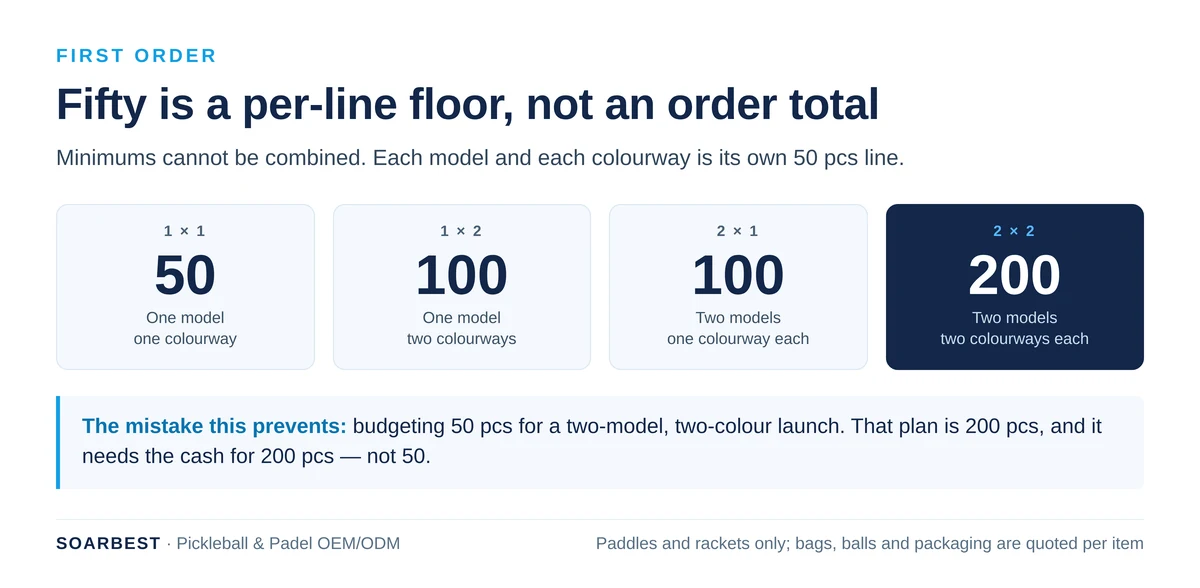
At SOARBEST the standard starting MOQ for paddle projects is 50 units per model, per colourway, subject to written confirmation for the project. One model in two colourways normally means 100 paddles. If you want two constructions and two colourways of each, use 200 units in your planning budget when the constructions are quoted as separate models.
| First-order plan | Units needed at 50 pcs per model-colourway |
|---|---|
| One model, one colourway | 50 |
| One model, two colourways | 100 |
| Two models, one colourway each | 100 |
| Two models, two colourways each | 200 |
Ask how the factory will count each variant. For example, 14 mm and 16 mm versions may be quoted as separate models even if they share graphics and a family name. Confirm whether the quote has separate minimums for branded cartons, grips, bags or other add-ons before budgeting a bundle.
To size a specific plan, open the first-order calculator, set the number of model and colourway combinations, and copy the generated estimate straight into your brief.
Price the launch as well as the paddles
Once the quantity is settled, budget the whole launch rather than the paddle unit price alone.
Estimate landed cost using the quoted units and all relevant one-off and delivery costs. Ask which sampling, artwork setup and packaging charges are included, and budget for testing, freight, duties and other applicable import costs. Put the deposit and balance on your cash calendar alongside the expected sales window. That gives you a basis for deciding whether your second SKU belongs in the first order or the reorder.
If you are deciding which construction deserves the first 50 units, compare the available ODM development routes.
What the timeline looks like
From the day the specification is locked:
| Stage | Working days | Calendar |
|---|---|---|
| Sampling | about 15 days per round | 3–4 weeks |
| Bulk production | 45-60 working days | about 9-12 weeks |
| Sea freight to US or EU | 30–40 days | 5–6 weeks |
| Consolidation and inbound booking | about 1 week | 1 week |
| Total, one sampling round | roughly 5 months |
Two things follow from that table. First, a 50-pc run takes the same calendar time as a full bulk run — small volume does not buy speed, it only buys a smaller invoice. Second, if you are planning a spring launch, the sampling window is the thing you book now, not the production slot.
What to run in parallel
The five months are mostly waiting, so use them:
- Brand assets. Logo, packaging artwork, and the bag design can all be developed while the paddle samples are in review.
- Compliance paperwork. For the US, the paddle must be on the USA Pickleball approved list before you market it as approved; that submission is the brand’s, and it takes time. Start it as soon as the final spec is locked.
- Channel conversations. Talk to the retail or club account that will take the first 50 units before the bulk run starts, not after.
- Second order planning. Decide the second model now, so the factory can hold tooling and materials.
What we will not do
We will not quote 50 units as if it were 1,000, and we will not promise a launch date that assumes zero sampling revisions. We will not tell you a factory can be “USA Pickleball certified” — it cannot; only your product can be listed, and only you can submit it.
We also will not split 50 across four models to make the order look bigger. It does not make the order better, it makes the sampling round longer and the sell-through data useless.
Three questions buyers ask before the first order
“Can we do 150 to test?” Yes — a 150-piece trial can be quoted. If it covers more than one model or colourway, each line must still meet the 50-pc minimum; 150 pieces cannot cover four separate 50-pc lines. Pricing depends on the model, artwork, packaging and whether new tooling is required, and each configuration is quoted separately.
“Can we mix two models in one 50?” No. 50 pcs applies per model, per colourway. Two models are two separate 50-pc lines, even when they share face material, thickness and print method. If you order them together, plan 100 pcs and two sampling approvals.
“What if the first order does not sell?” Then the second order is the one that matters. Plan the second model now so that a slow first quarter does not stop the range.
Next step
If you have a first range in mind, send the model count, the colourway count, and your launch window. We will tell you which of the three has to move — usually the colourway count.
Related: How a buyer reads a paddle spec sheet, Thermoformed vs cold-press, USA Pickleball testing.
Product lines: Private-label pickleball paddles · Custom padel rackets · Racket bags and covers