
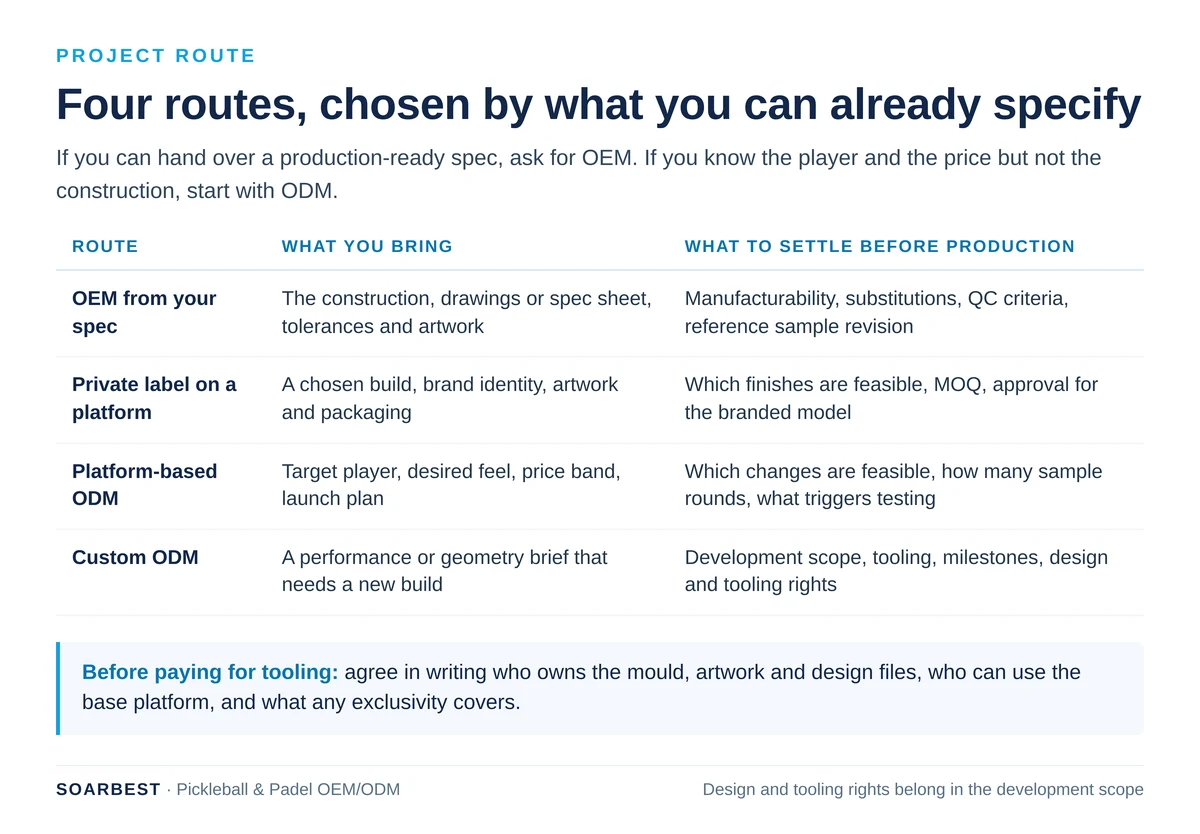
The quickest way to choose an OEM or ODM route is to ask what your team can already specify. If you can hand over a production-ready specification, ask for an OEM review. If you know the player, feel and price point you want but need help defining the construction, start with ODM. If the construction already suits your range and you mainly need your brand on it, ask about private label.
| Route | What you bring | What to settle before production |
|---|---|---|
| OEM from your specification | The construction, drawings or spec sheet, tolerances and artwork, with a reference sample if available. | Manufacturability, any approved substitutions, QC criteria and the reference sample revision. |
| Private label on an existing platform | A chosen build, brand identity, artwork and packaging requirements. | Which finishes and artwork are feasible, MOQ, and any approval needed for the branded model. |
| Platform-based ODM | A target player, desired feel, price band and launch plan. | Which changes are feasible on the base platform, how many sample revisions are scoped and what triggers extra testing. |
| Custom ODM | A performance or geometry brief that calls for a new build. | Development scope, tooling costs, milestones, design and tooling rights, and planned approval steps. |
Work from the problem your paddle needs to solve
Suppose your brand sells to club players who want a quick-feeling paddle at the net. Give the development team competing examples, your preferred weight and balance range if known, and the retail price you need to hit. Ask for two feasible sample directions before committing to tooling. Judge both samples against the same handling, feel and price criteria.
If a supplier already has a platform you want to adapt, specify exactly what should carry over. A change to core thickness or face construction can alter play feel and may affect the testing or approval route. Review those changes before graphics and packaging are finalized.
Before paying for custom tooling or design, agree in writing who owns the mould, artwork and design files, who can use the base platform, and what any exclusivity covers. Put the number of sample rounds, sign-off points and charges for later revisions in the development scope.
See how SOARBEST scopes OEM and ODM paddle development.
Have a drawing, reference paddle or product brief? Share what is fixed and which decisions are still open. We can discuss whether an existing platform, your specification or a new build best fits the project. Start a Project